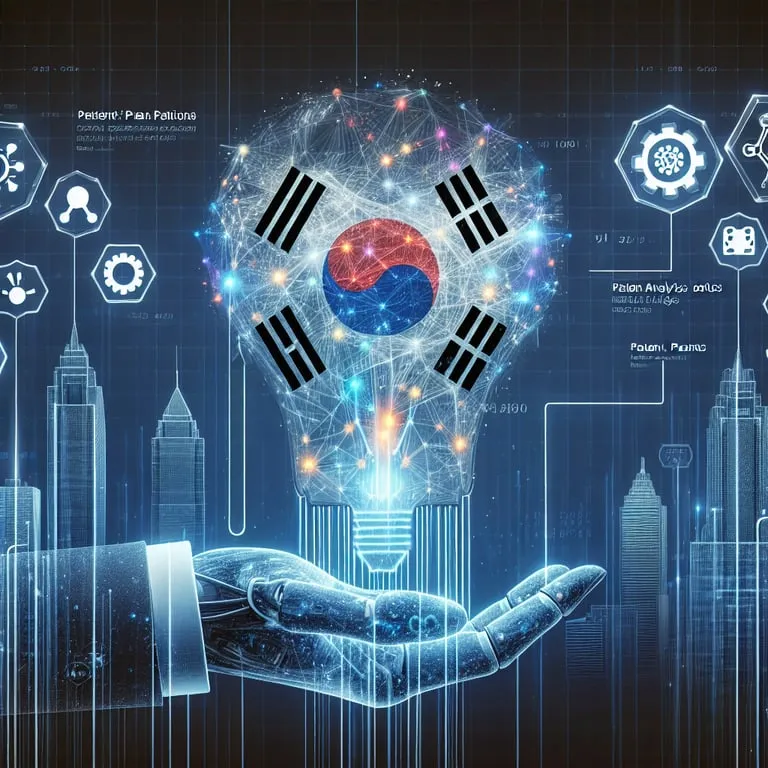
How Korea’s AI‑Driven Patent Analytics Tools Influence US Tech Strategy
If you’ve felt like the ground under US tech strategy has been quietly shifting, you’re not imagining it요
Korea’s AI‑driven patent analytics tools are one of those under‑the‑radar forces nudging product roadmaps, licensing tactics, and even M&A shortlists in 2025요
Why Korean AI patent analytics matter now
The sheer density of Korean IP output
Korea consistently ranks among the top global sources of patent filings, with over 20,000 PCT applications annually and hundreds of thousands of domestic filings coursing through KIPO each year다
That volume isn’t just a headline number요
It creates incredibly dense citation networks in semiconductors, batteries, displays, communications, and robotics, which AI tools can mine for non‑obvious adjacencies and early signals요
US teams tracking these graphs spot white spaces 6–12 months before competitors relying on English‑only dashboards do요
The cross‑lingual wall just got thinner
Legacy search relied on brittle keyword mapping between Korean and English, missing synonymy, morphology, and domain jargon다
Modern Korean platforms embed full claims and specs with cross‑lingual transformers like XLM‑R and domain‑tuned sentence‑BERT, aligning Korean and English in the same vector space요
That means a US counsel typing “solid‑state electrolyte interphase stability” can retrieve high‑value KR filings even when the original terms are nowhere near the English phrasing요
Precision@10 and recall in difficult long‑tail queries often improve by double digits versus keyword baselines, and practitioners feel the difference in fewer false negatives요
Standards and SEPs are a Korean stronghold
From 5G to 6G pre‑standards, from HEVC to VVC, and from Bluetooth LE Audio to Wi‑Fi 7, Korean assignees like Samsung, LG, and ETRI anchor a large share of forward‑cited families다
AI tools that label standard‑essential candidates by tracing disclosure links, contribution logs, and citation cascades let US teams run faster SEP exposure modeling and licensing prioritization요
Instead of waiting for formal essentiality determinations, counsel can see “likely‑SEP clusters” weeks after a 3GPP meeting packet drops요
Under the hood of Korea’s new‑wave platforms
Cross‑lingual embeddings plus retrieval augmentation
Contemporary Korean systems pair dense retrieval with hybrid rerankers that blend BM25 and neural scoring다
They reduce the “silent miss” problem in novelty and FTO searches, especially on emerging terms like chiplet interconnect, z‑pin carbon composites, and quasi‑2D perovskites요
Several vendors fine‑tune on examiner‑labeled relevance sets from KIPO, pushing MRR and nDCG scores above what generalist Western tools achieve on Korean corpora요
Knowledge graphs with industrial taxonomies
Beyond CPC/IPC, they maintain proprietary taxonomies for EV batteries, OLED stacks, e‑paper, HBM, and advanced packaging like FOWLP and 2.5D interposers다
Graph algorithms like PageRank, HITS, and community detection rank influential families and reveal thickets where litigation risk spikes요
Assignee disambiguation for Korean entities—often the hardest piece—is solved with ensemble entity resolution that fuses hangul variants, romanization, address hashes, and corporate registry data요
Multimodal and materials‑aware search
Design and semiconductor claims often hinge on images, figures, or spectra다
Korean tools increasingly embed drawings via vision transformers and pair them with text embeddings so you can search “like‑this layout” across KR design filings요
In materials, spectral and crystalline descriptors map to text claims, allowing similarity search for “ionic conductivity above 10⁻³ S/cm at 25°C” alongside known composition families요
Generative layers with guardrails
LLM copilots summarize independent claims, produce 3‑line “examiner abstracts,” and draft office‑action response checklists요
Crucially, they cite paragraph‑level evidence and keep chain‑of‑custody logs to meet in‑house QA and privilege constraints다
When tuned on patentese and trained to avoid “creative paraphrase,” they hit low hallucination rates with retrieval‑grounded citations, which is what counsel actually needs요
How US teams are using Korean platforms in 2025
White‑space validation and R&D targeting
US R&D leaders run quarterly “white‑space” scans using Korean datasets to validate internal hunches다
If a gap appears thin in US and EP filings but thick in KR pre‑grants, that’s a siren that the space may be crowded sooner than your US‑only lens suggests요
Teams now tie these maps to TRL scoring, feeding gate decisions at PRD and concept commit stages요
FTO that actually answers the business question
FTO used to drown in PDFs요
Now, dashboards flag families with broad independent claims, big family size, early priority dates, and high forward‑citation velocity다
Alerts catch KR continuations or divisional filings that might have flown under an English‑only radar요
Procurement uses this to swap suppliers or tweak specs before POs are locked, shaving months off remediation timelines요
SEP exposure and licensing leverage
US handset, network, and IoT device makers simulate SEP exposure using Korean likelihood models tied to 3GPP work items and change requests요
They cluster claims by feature sets—HARQ, sidelink, NR‑RedCap—and estimate royalty stack scenarios under FRAND assumptions다
This produces a license‑first posture when exposure is high and a defensive publication sprint when exposure is low요
Venture and M&A scouting beyond the usual suspects
Because many Korean startups publish first in Korean and only later in English, the earliest signals often live in KR pre‑grants요
Corporate venture teams map startup claims to incumbent thickets to predict negotiation power and post‑merger R&D velocity다
Deal teams love “claim‑to‑product” overlays that translate IP into SKU‑level roadmap impact, which is where strategy actually bites요
Metrics that travel well from patents to the boardroom
Portfolio quality not just portfolio size
Patent Asset Index, Technology Relevance, and Competitive Impact are useful, but they’re even better combined with claim‑level features다
Independent claim token length, functional term density, and family geographic spread correlate with blocking power in several Korean‑heavy domains요
Forward‑citation half‑life often beats raw counts as a leading indicator of durability요
Litigation and PAE risk early warning
AI models score “litigability” by blending assignee behavior, venue norms, and semantic overlap with historically asserted claims다
Korean data fills blind spots where US‑centric datasets undercount family linkages요
When the risk spikes, US teams rehearse non‑infringement and design‑around options before demand letters land요
Standards alignment scorecards
Tools align claims with standards clauses and contribution logs, then visualize “coverage by feature” for 5G‑Advanced and early 6G features다
Legal can pre‑negotiate cross‑licenses using these heatmaps, saving months in arbitration or rate setting요
A vignette of influence across sectors
EV batteries and the solid‑state inflection
Korean portfolios in cathode chemistries, dry‑electrode processes, and solid electrolytes are dense and fast‑moving다
US OEMs and Tier‑1s run KR‑first horizon scans to decide whether to co‑develop, license, or pursue alternative chemistries요
When the models show a narrow white space near sulfide glass‑ceramics with improved interphase stability, it can trigger a targeted sprint or a partnership call within a week요
HBM, chiplets, and advanced packaging
With HBM adoption surging for AI, packaging IP around TSV reliability, thermal paths, and interposer routing is hot요
Korean assignees dominate slices of this stack, and AI graphs reveal cross‑licensing triangles that suggest who will settle versus who will litigate다
Operations uses this to derisk supply while design pivots around likely blocking claims요
Displays and XR optics
From tandem OLED to micro‑OLED for XR, KR filings often preview manufacturing constraints that never make the press요
Spotting these six months early helps US product planners avoid painted corners on yields and BOM surprises요
Governance, compliance, and trust you can defend
Data provenance and auditability
US legal teams require evidentiary chains that survive internal audit다
Korean platforms now log every retrieval step, model version, and snippet citation so you can reproduce a search six months later요
That audit trail builds trust when decisions get board‑level scrutiny요
Privacy, export controls, and safe collaboration
Sensitive queries and drafts stay sandboxed with regional hosting options and KMS‑backed encryption요
Role‑based access and redaction prevent leakage of unreleased product codenames while still letting outside counsel collaborate다
Hallucination controls that matter in IP
Generative layers are retrieval‑grounded and citation‑first요
If a sentence can’t be pinned to a paragraph ID, it’s labeled low‑confidence rather than confidently wrong다
That sounds simple, but in legal work it’s everything요
A 90‑day playbook for US teams
Week 0 to 2 choose the right stack
- Require cross‑lingual dense retrieval with transparent benchmarks on KR corpora다
- Ask for entity resolution accuracy on Korean assignees above 95% F1 with real confusion examples요
- Confirm audit logs, on‑prem or VPC deployment, and red‑team results on prompt injection다
Week 3 to 6 wire into real decisions
- Build a white‑space view tied to next two PRDs and procurement gates요
- Stand up FTO alerts for KR pre‑grants in your top five CPC classes다
- Add a SEP likelihood board for your standards program with monthly refresh요
Week 7 to 12 make it muscle memory
- Run a mock assertion and design‑around exercise on a KR family you genuinely fear다
- Present a one‑page metric stack to the exec team, translating IP signals into shipment risk and gross margin impact요
- Capture wins and false alarms to tune thresholds and keep humans in the loop요
What this means for US strategy in 2025
Speed, not just insight
The big shift is cycle time다
When a KR pre‑grant pops and the tool pushes a red‑flag card to counsel the same morning, the difference is weeks of advantage요
Better bets with less drama
You’ll kill the wrong bets faster and double‑down on the right ones with fewer 2 a.m. crisis calls요
That’s what good intelligence always promised, and now it’s finally here다
Collaboration over confrontation
Armed with clearer maps of overlap, US and Korean companies are cutting cleaner deals, forming cross‑licenses earlier, and spinning up joint development where it actually makes sense요
That doesn’t eliminate litigation, but it changes the default from fight‑first to model‑first다
Quick pointers to reputable Korean sources
Public and commercial platforms to know
- KIPRIS and KIPRIS‑N for public search and early KR visibility요
- WIPS Global and similar commercial datasets for cross‑lingual semantic retrieval and analytics다
- Academic and institute releases from ETRI and major universities for NLP and IP data pipelines요
Benchmarks to ask vendors
- Recall and precision on KR‑EN novelty queries in your CPC classes요
- Entity disambiguation accuracy for Korean SMEs and chaebol affiliates다
- Latency SLAs for pre‑grant ingestion and machine translation refresh요
People and process still matter
Even with top‑tier tools, the best outcomes pair a sharp IP strategist with a curious PM and a skeptical counsel요
That trio turns dashboards into decisions, and decisions into momentum다
Pulling it together, Korea’s AI‑driven patent analytics aren’t a niche curiosity anymore요
They’re informing real US tech choices—what to build, what to buy, what to license, and where not to step—and they’re doing it fast enough to matter다
If you wire these tools into your 2025 operating rhythm, you’re not just watching the future unfold, you’re meeting it a little early요 ^^
답글 남기기